
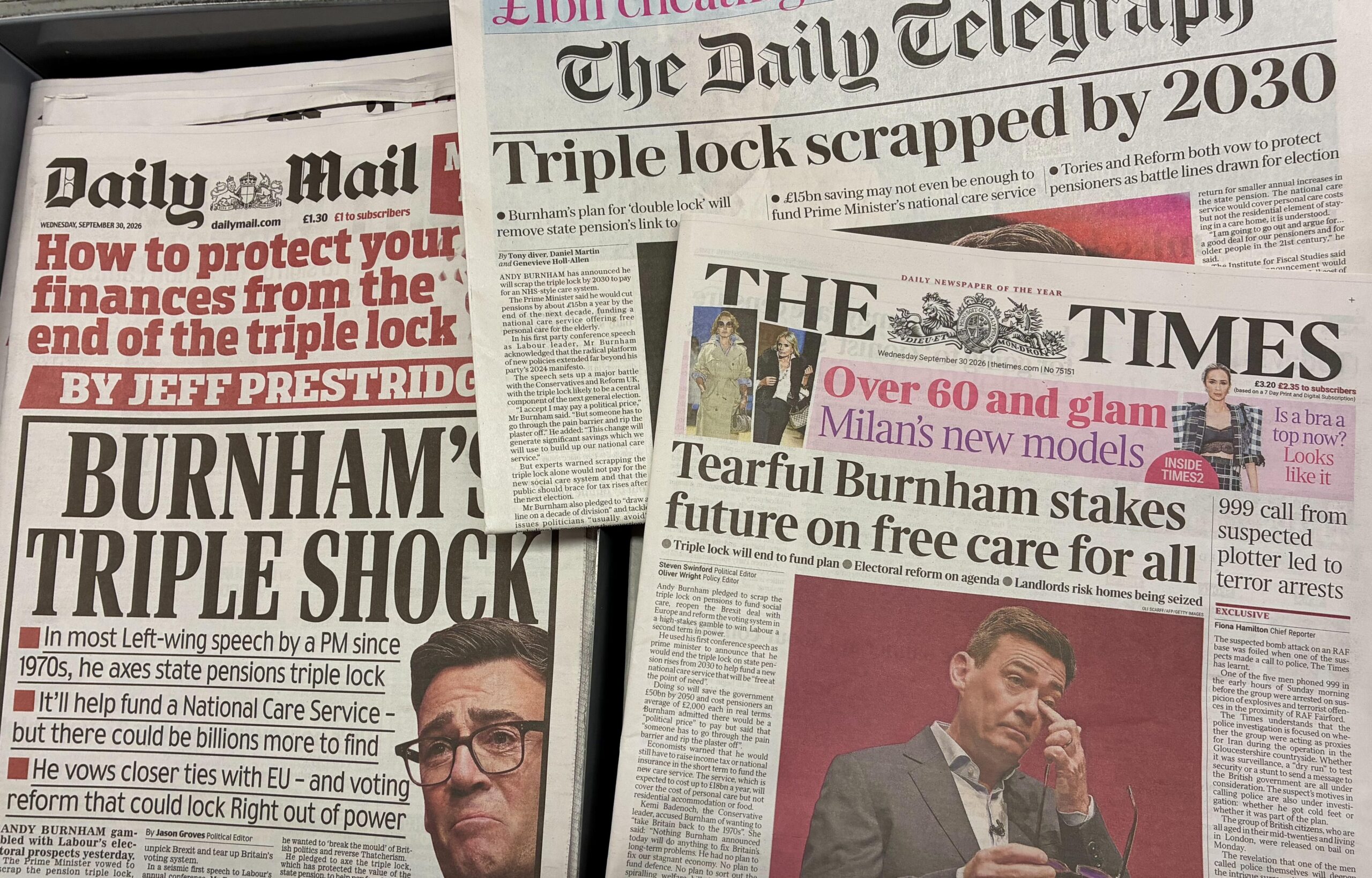
Few political issues combine fiscal pressure, intergenerational fairness and electoral risk quite like the State Pension ‘Triple Lock’. Andy Burnham’s conference pledge to replace it with a ‘double lock’ from 2030 – removing the earnings link while retaining protection against inflation or a 2.5% floor – was designed to show that Labour is willing to take difficult long-term decisions to fund a new national care service. But Yonder’s latest polling suggests the politics are far from straightforward. The public is split almost evenly on the plan, older voters are firmly opposed, and the Conservatives and Reform UK have already found the attack line Labour will have to answer: is this responsible reform, or simply a cut to pensioners’ incomes?
Our polling (driven by Yonder Omnibus) conducted over the weekend – after voters and the media have had a chance to digest the announcement – has found the planned reform has split the public almost equally between supporters and opponents.
- 30% support the Prime Minister’s plan to adjust the State Pension ‘Triple Lock’
- 32% oppose the Prime Minister’s plan
- 36% agree that “the Prime Minister’s plan to adjust the State Pension ‘Triple Lock’ is an unreasonable attack on pensioners”
While the public is evenly balanced between opponents and supporters of the PM’s plan, a core challenge for the Government is that the ‘Triple Lock’ is not currently especially unpopular. In fact, the opposite is true: on balance, people see it as fair, a good use of taxpayers’ money and an appropriate recognition of the country’s responsibility to pensioners.
- 45% of UK adults say the State Pension ‘Triple Lock’ is fair, compared with 17% who say it is unfair
- 43% say the State Pension ‘Triple Lock’ is a good use of taxpayers’ money, compared with 18% who say it is a poor use of taxpayers’ money
- 40% say the ‘Triple Lock’ should remain exactly as it is, compared with 24% who say it should be reformed in some way
- 50% agree that the ‘Triple Lock’ “is a good and appropriate demonstration of the value that we as a country place on supporting pensioners”, compared with 17% who agree it “is a demonstration of the disproportionately large amount of support that the country gives to pensioners compared with younger people”
Overall, therefore, the public mood seems to start from an unsympathetic position for Andy Burnham’s plans. And when we explore reaction to the PM’s announcement specifically, we find further evidence that ‘Triple Lock’ reform will be a divisive and thorny issue.
- After reading a brief introduction to the Prime Minister’s plan to adjust the State Pension ‘Triple Lock’, 32% oppose the plan and 30% support the plan
- 34% agree that “any money saved by the adjustment to the State Pension ‘Triple Lock’ will just be used to fund whatever short-term financial pressures are faced by the government”, compared with 31% who agree that “any money saved by the adjustment to the State Pension ‘Triple Lock’ will help fund a new national care service”
- 36% agree that “the Prime Minister’s plan to adjust the State Pension ‘Triple Lock’ is an unreasonable attack on pensioners”, whereas fewer (29%) agree that “the Prime Minister’s plan to adjust the State Pension ‘Triple Lock’ is a reasonable attempt to address the financial pressures facing the government”
- Interestingly – and despite other alarming findings for Andy Burnham – support for the Prime Minister’s plan was slightly higher (once respondents had been introduced to it) than the proportion who said the ‘Triple Lock’ should be reformed in some way earlier in our survey (30% vs 24%). It is an indication that the Prime Minister’s association with the change helped increase support very slightly.
- Younger voters are open to Andy Burnham’s plan but opposition increases significantly with age. On balance, 18-34 year olds and 35-54 year olds are more likely to support than oppose the PM’s plan but the balance flips for those aged 55+. 59% of 65-74 year olds and 58% of those aged 75+ oppose the plan.
The party-political split is equally clear. Labour, Liberal Democrat and Green voters are more inclined to accept the Prime Minister’s argument that reform is a reasonable response to fiscal pressure. Conservative and Reform UK voters, in contrast, are already much more likely to see the proposal as an attack on pensioners.
- Support for Prime Minister’s plan to adjust the State Pension ‘Triple Lock’ is at 55% among likely Labour voters, 48% among likely Lib Dems and 44% among likely Greens
- Opposition to the Prime Minister’s plan to adjust the State Pension ‘Triple Lock’ is at 51% among likely Conservative voters and 55% among likely Reform UK voters
- 53% of likely Labour voters, 41% of likely Lib Dems and 42% of likely Greens agree “the Prime Minister’s plan to adjust the State Pension ‘Triple Lock’ is a reasonable attempt to address the financial pressures facing the government”
- 62% of likely Reform UK voters and 56% of likely Conservative voters agree that “the Prime Minister’s plan to adjust the State Pension ‘Triple Lock’ is an unreasonable attack on pensioners”
Kemi Badenoch has reiterated the Conservatives’ ongoing support for the Triple Lock, while Reform UK’s opposition to any change was made explicit when Nigel Farage said “By potentially scrapping the triple lock, Andy Burnham will abdicate his responsibility to British pensioners”. Reform UK’s Robert Jenrick further underlined the likely messages we’ll see at the next election when he said: “It’s official: Andy Burnham wants to cut your pension”.
‘Triple Lock’ reform is not impossible, but Andy Burnham is a long way from winning the debate. One-in-five UK (19%) adults have heard little or nothing of the ‘Triple Lock’, almost a quarter (23%) have heard nothing yet about the Prime Minister’s desire to adjust it, and nearly four in ten (38%) neither support nor oppose the plan. That gives the Government room to persuade, but also gives its opponents room to define the policy first. If Labour can make the link between pension reform and a national care service credible, tangible and fair, it may yet win the argument. If it cannot, “cutting your pension” will be the simpler and more politically potent message. Either way, the issue now looks set to become one of the clearest dividing lines of the next general election.
Methodology
Yonder interviewed 2,064 adults (aged 18+) in the United Kingdom online between 2 and 4 October 2026. Demographic quotas and weights were used to ensure the sample was demographically representative of the GB adult population. Additionally, the survey’s sample of 2024 General Election voters in Great Britain was weighted to represent the known result of the 2024 General Election in Great Britain.
For data tables, click here.