For the first time in a long time, Labour looks like it has momentum. Andy Burnham’s arrival in Downing Street has not transformed the political landscape overnight, but it has changed the mood. After months of drift and declining support, Labour has seen a boost and, in some polls, even a crossover.
For businesses trying to understand where British politics is heading, Andy Burnham’s first weeks in office are worth watching closely. Labour’s polling recovery is an early signal of how the new Prime Minister may govern, which voters he is trying to win back, and where policy pressure is likely to build.
Burnham became Prime Minister on 20 July with Labour already showing signs of recovery. Voters appeared ready to give the party another look after Keir Starmer’s leadership, and Labour’s win in the Greater Manchester mayoral by-election gave the new Prime Minister a useful early proof point. Since then, the polling picture has continued to improve.
Strikingly, we are now seeing signs of ‘crossover’: Labour moving ahead of Reform UK, the Conservatives and other parties in several voting intention polls published at the end of July and beginning of August.
Our own Yonder Omnibus polling, conducted on 29 and 30 July, points in the same direction. When asked how likely they are to vote for each party at the next election, 23% of GB adults said they are likely to vote Labour (giving a score of 7-10 on a 0-10 scale). That compares with 22% for the Conservatives and 20% for Reform UK.
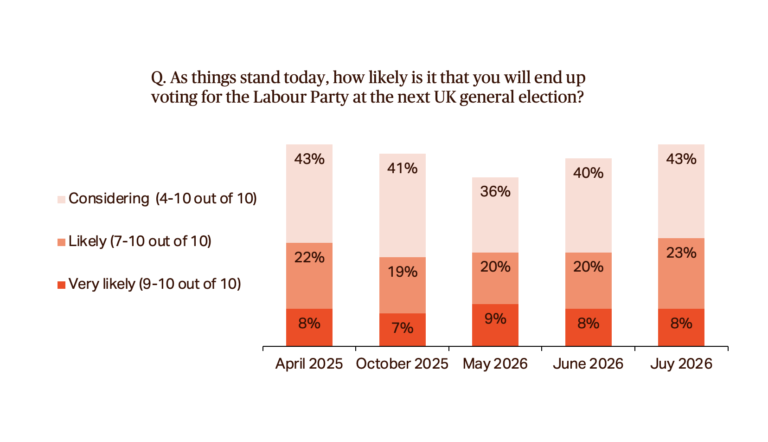
In the context of the past year, they are meaningful numbers even if they remain far below Labour’s highs leading into the 2024 General Election. Labour’s likely vote has risen from a low of 19% in October 2025, while the proportion of voters considering Labour (giving a score of 4-10 on a 0-10 scale) has increased from 36% in May 2026 to 43% in late-July.
That distinction matters. Burnham has not yet turned sceptical voters into committed Labour voters at scale. But he has expanded the pool of people willing to listen. For any government seeking to reset its relationship with the public, that is the first necessary step.
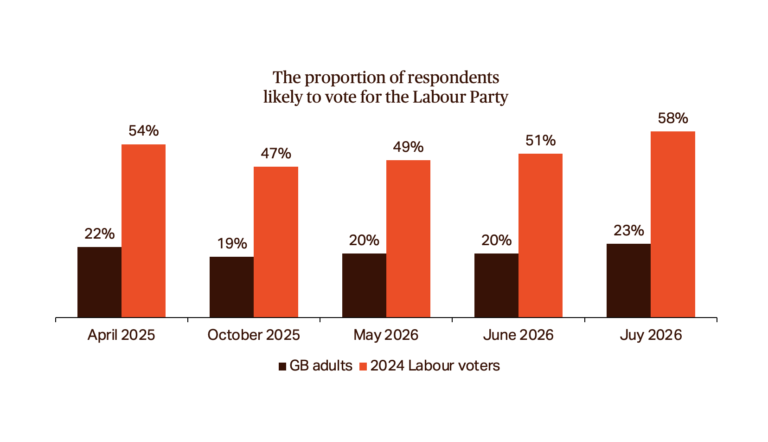
Part of the improvement comes from Labour winning back some of its own. At one of the party’s low points, in October 2025, just 47% of 2024 Labour voters told us they were likely to vote Labour again. That figure has now risen to 58%. In other words, Burnham’s early success is less about converting the country wholesale and more about repairing a damaged coalition.
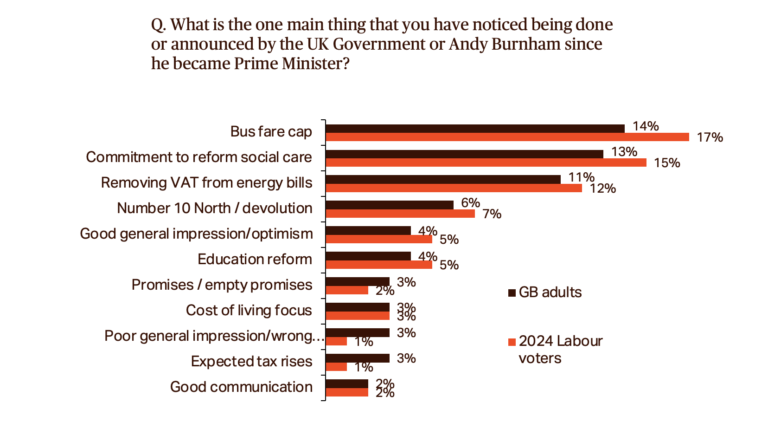
The government has also benefited from a burst of visible activity. When we asked voters to name, spontaneously, the one main thing they had noticed being done or announced by the UK Government or Andy Burnham since he became Prime Minister, more than three-quarters (78%) named something. Among 2024 Labour voters, that rose to 84%.
Political announcements often fail to travel beyond Westminster, SW1 social media and the day’s broadcast round. Burnham’s early agenda appears to have cut through and, for a new Prime Minister trying to demonstrate change, that is significant.
The most commonly recalled announcements were the bus fare cap, mentioned by 14% of GB adults; the commitment to reform social care, mentioned by 13%; and removing VAT from energy bills, mentioned by 11%. Other voters pointed to Number 10 North and devolution, education reform, and a broader focus on the cost of living.
This tells us something about the political environment facing businesses as well as parties. Voters are responding to policies that feel tangible, local and immediate. Transport costs, energy bills and social care are not abstract ideological debates, they are household pressures. Businesses should expect this government to continue leaning into policies that can be presented as practical interventions in everyday life.
But the uplift in visibility comes with risks. Some voters are already hearing “promises” rather than delivery. 3% volunteered that the government was making empty promises, 3% gave a generally negative response, and 3% mentioned an expectation of tax rises. Those numbers point to an emerging challenge for Burnham: expectations are rising before the hard trade-offs have arrived.
That is especially important for organisations trying to plan ahead. A government with improving polling may feel more confident, but it may also become more interventionist. Social care reform, devolution, energy bills, transport and taxation all have direct implications for sectors across the economy. The political mood is shifting from drift to activity, and that means businesses need to pay attention not just to policy announcements, but to the voter pressures driving them.
There is also the question of timing. Labour’s numbers have improved since late 2025 and early 2026, but they are still broadly similar to where they were in April 2025. This is a recovery – maybe even a short-lived one – and not yet a transformation.
Nevertheless, Burnham has secured the bounce Labour hoped for. Whether it lasts is another matter. If the polling improvement continues, speculation about an early general election will grow – particularly if the government argues it needs a stronger mandate to tackle difficult issues such as social care, defence or a broader reforming agenda. We could see a return to the polling booths sooner than expected. In the infamous words of Brenda from Bristol: “Not another one.”
Methodology
Yonder interviewed 2,004 adults (aged 18+) in Great Britain online between 29 and 30 July 2026. Demographic quotas and weights were used to ensure the sample was demographically representative of the GB adult population. Additionally, the survey’s sample of 2024 General Election voters in Great Britain was weighted to represent the known result of the 2024 General Election in Great Britain.
Burnham incoming: Labour’s reset meets the reality test
Andy Burnham is widely expected to become leader of the Labour Party and Prime Minister – perhaps even in time

The Green tide: how voter disillusionment is reshaping the UK’s political landscape
The current surge in support for the Green Party is not just a headache for Labour; it’s a symptom of