
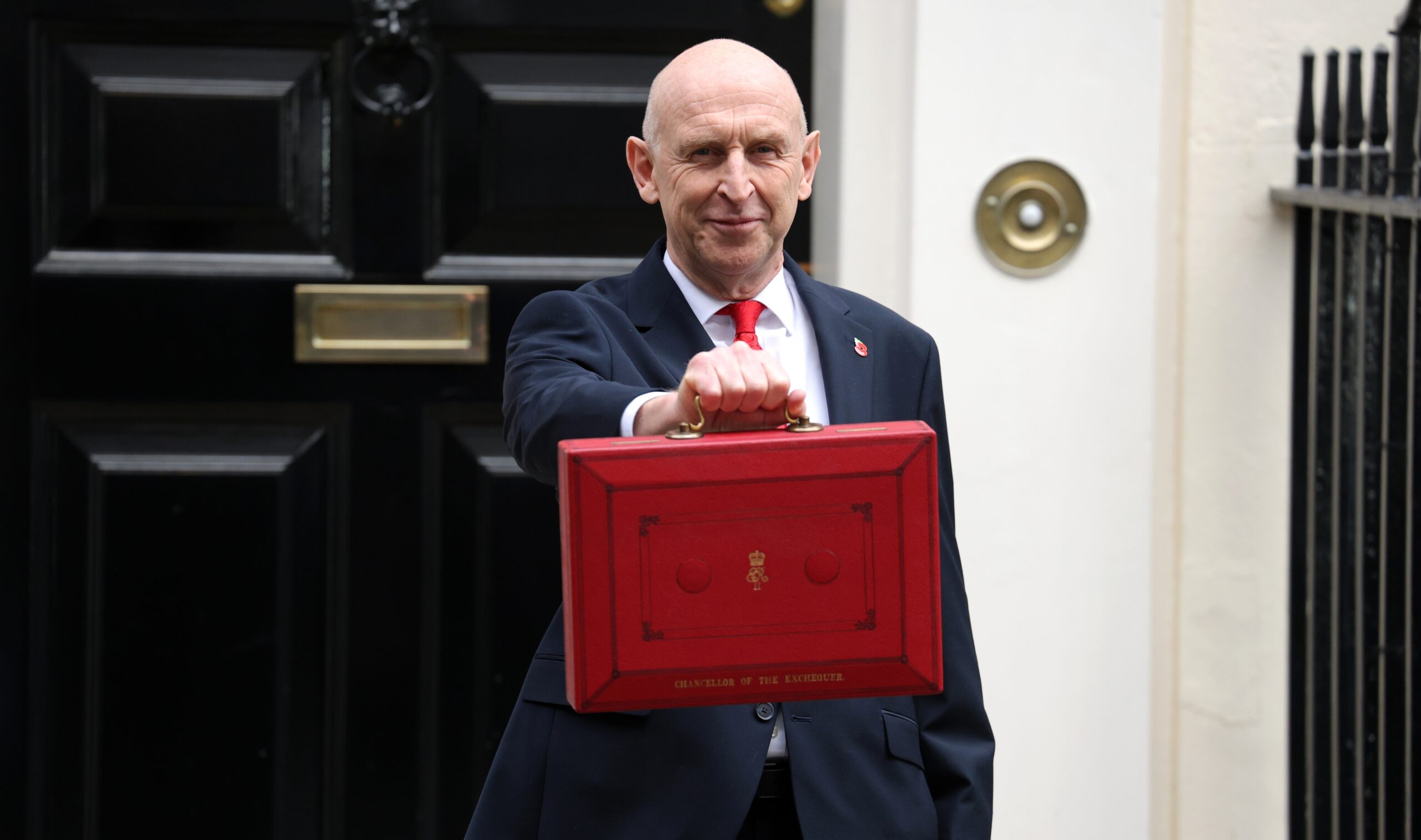
The strongest test of a Budget is not how many measures it contains, but the story a government tells its voters – and whether those voters believe the government is making a positive difference to their lives. In the days after John Healey’s first Budget, one announcement stood out: a £100 Household Energy Payment. But beyond that, Yonder’s polling points to a more difficult story for Andy Burnham’s Labour government: many people struggled to identify what the Budget was trying to achieve.
The Budget landed amid global conflict, disrupted supply chains, high public debt, pressure on government borrowing and rising demand for health and welfare spending. Those are real constraints that reduce any Chancellor’s ability to impress voters. However our polling also points to a national economic malaise that the Budget has failed to lift us out of.
In the lead-up to the Budget, during Andy Burnham’s first months as Prime Minister, there had been a significant improvement in satisfaction with the Government compared with the lows recorded under Keir Starmer. Before the 2025 Budget, 13% were satisfied with the Labour Government’s performance, and 67% dissatisfied: a net satisfaction score of -54. Before the 2026 Budget, 29% were satisfied with the Government led by Andy Burnham, and 34% dissatisfied. Meanwhile our latest post-Budget survey puts satisfaction at 27%, while dissatisfaction has risen to 37%. The net score has slipped from -5 before the Budget to -10 afterwards.
This small deterioration may prove temporary, but could this be the end of Andy Burnham’s honeymoon? It is certainly a reminder that political goodwill is limited. A Government may be able to explain its difficult inheritance and the pressures on the public finances; it may have less time to persuade voters that those constraints are an answer in themselves.
A payment people noticed – but a Budget they found underwhelming
In our post-Budget polling – powered by Yonder Omnibus – we asked UK adults what, if anything, they had heard most about from the Budget. The clearest takeaway is that its most memorable announcement was also its most immediate: the £100 Household Energy Payment. It was mentioned by 29% in our first post-Budget survey (which began the afternoon of the Budget), and 30% in the follow-up survey over the weekend.
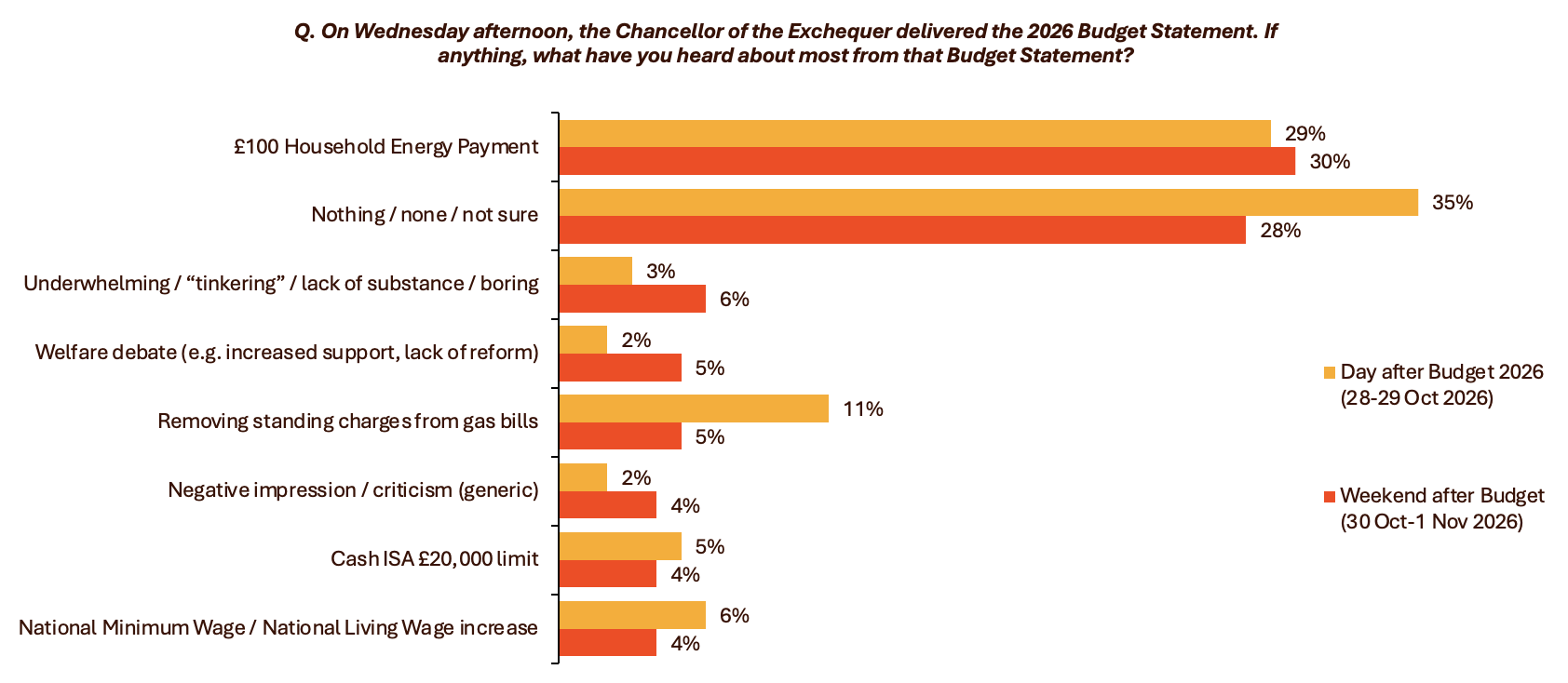
Beyond that, the pattern was less about a coherent programme than a handful of announcements. The removal of standing charges from gas bills was recalled by 11% in the first poll, but 5% in the second. The National Minimum Wage and National Living Wage increase was mentioned by 6% and then 4%; the commitment to retain the £20,000 Cash ISA limit by 5% and then 4%.
Meanwhile, the proportion describing the Budget as “underwhelming”, lacking substance or “tinkering” rose from 3% to 6%. Mentions of the welfare debate (with mostly negative sentiment from the Government’s perspective) rose from 2% to 5%, and generic negative or critical reactions from 2% to 4%. The proportion saying they had heard nothing, or were unsure, fell from 35% to 28%.
These are measures of what people recalled, not a verdict on every policy. But the shift between the two surveys is telling: as media coverage continued over the weekend, more people appeared to describe the Budget’s overall character, rather than name a particular measure. The £100 payment remained prominent, but a sense of limited ambition became more visible.
The comments people gave capture that frustration:
“It seems like a lot of hot air. It doesn’t actually do much to benefit me, I won’t get more money in my pocket and they have kicked the can down the road on important decisions.”
Others described a Budget of “small changes” that did little to address the underlying problems. The cost of living and frozen income tax thresholds featured in criticism, alongside a perceived lack of clarity on welfare reform and defence spending.
This is a familiar communications challenge for governments operating under fiscal pressure. A package can be technically substantial yet struggle to feel meaningful if its benefits are hard to see, limited in scale or overshadowed by unresolved questions. The energy payment was easy to understand and recall, but the wider case for the Budget – and how it would improve the country’s economic prospects – appears to have been harder to land.
Growth remains a promise, not a source of confidence
The Budget did little to improve expectations for the economy. Before it, 19% were optimistic that the UK economy would grow over the next 12 months and 47% were pessimistic. In the latest post-Budget survey, optimism was 18% and pessimism stood at 49%.
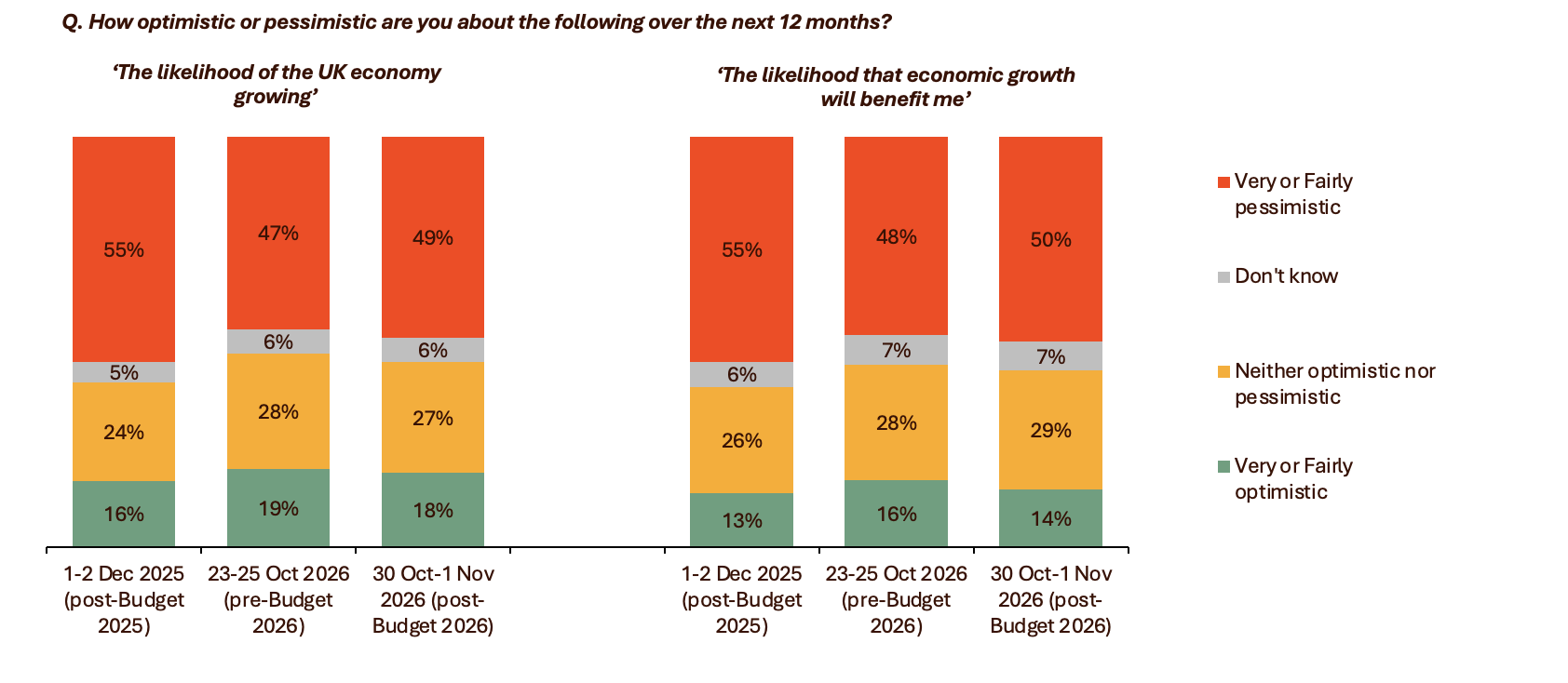
That lack of movement follows a similar pattern after the 2025 Budget. Under Keir Starmer, optimism about economic growth fell slightly from 19% pre-Budget to 16% post-Budget, while pessimism rose from 49% to 55%. By comparison, the 2026 figures suggest no meaningful post-Budget boost to confidence.
The harder test for any Government is whether people believe growth will benefit them personally. Here, the outlook is more troubling. Before the 2026 Budget, 16% were optimistic that economic growth would benefit them over the following year. In our latest poll, that optimism had fallen to 14%, while 50% were pessimistic. Even among those who expect the economy to grow (and few do), there may be doubts about whether they will feel the benefit.
That gap matters politically. ‘Growth’ is seen as a powerful political objective, but it is not yet a persuasive personal promise. If households continue to feel squeezed, broad claims about improving economic performance may struggle to offset immediate concerns about bills, tax and public services.
The political test ahead
The Government’s room for manoeuvre is limited, but our polling suggests that explaining these limits is not the same as building confidence. The Budget’s most recognisable measure was a one-off payment; the wider impression, for some, was of incremental adjustments rather than a plan for lasting change.
For Labour, the challenge is therefore not simply to defend difficult choices. It is to make the purpose of those choices clear, show how they connect to a credible route to growth, and demonstrate how that growth could improve people’s household finances. Without that connection, voters may continue to see the Budget – and Andy Burnham’s Government more generally – as reacting to events and constraints, rather than shaping what comes next.
Methodology
This article references three Yonder surveys conducted in October and November 2026 (powered by Yonder Omnibus).
- Pre-Budget survey: Yonder interviewed 2,065 adults aged 18+ in the UK online between 23 and 25 October 2026. Demographic quotas and weights were used to ensure the sample was demographically representative of the GB adult population. The sample of 2024 General Election voters in Great Britain was also weighted to the known result of the 2024 General Election. For data tables, click here.
- Post-Budget survey 1: Yonder interviewed adults aged 18+ in the UK online between 28 and 29 October 2026. Demographic quotas and weights were used to ensure the sample was demographically representative of the GB adult population. The sample of 2024 General Election voters in Great Britain was also weighted to the known result of the 2024 General Election. For data tables, click here.
- Post-Budget survey 2: Yonder interviewed 2,074 adults aged 18+ in the UK online between 30 October and 1 November 2026. Demographic quotas and weights were used to ensure the sample was demographically representative of the GB adult population. The sample of 2024 General Election voters in Great Britain was also weighted to the known result of the 2024 General Election. For data tables, click here.
Yonder is a member of the British Polling Council and abides by its rules.
Please see www.yonderconsulting.com for more information.