Measuring the mood: The pre-Budget barometer
In a landscape defined by economic pessimism, frustration with the status quo, and distrust in the government, the 2025 Budget Statement has managed to deepen existing anxieties. It demonstrates the difficult situation the government finds itself in, but also the ease with which control over the narrative can be lost.
In our pre-Budget research (powered by Yonder Omnibus), we uncovered a deeply entrenched scepticism:
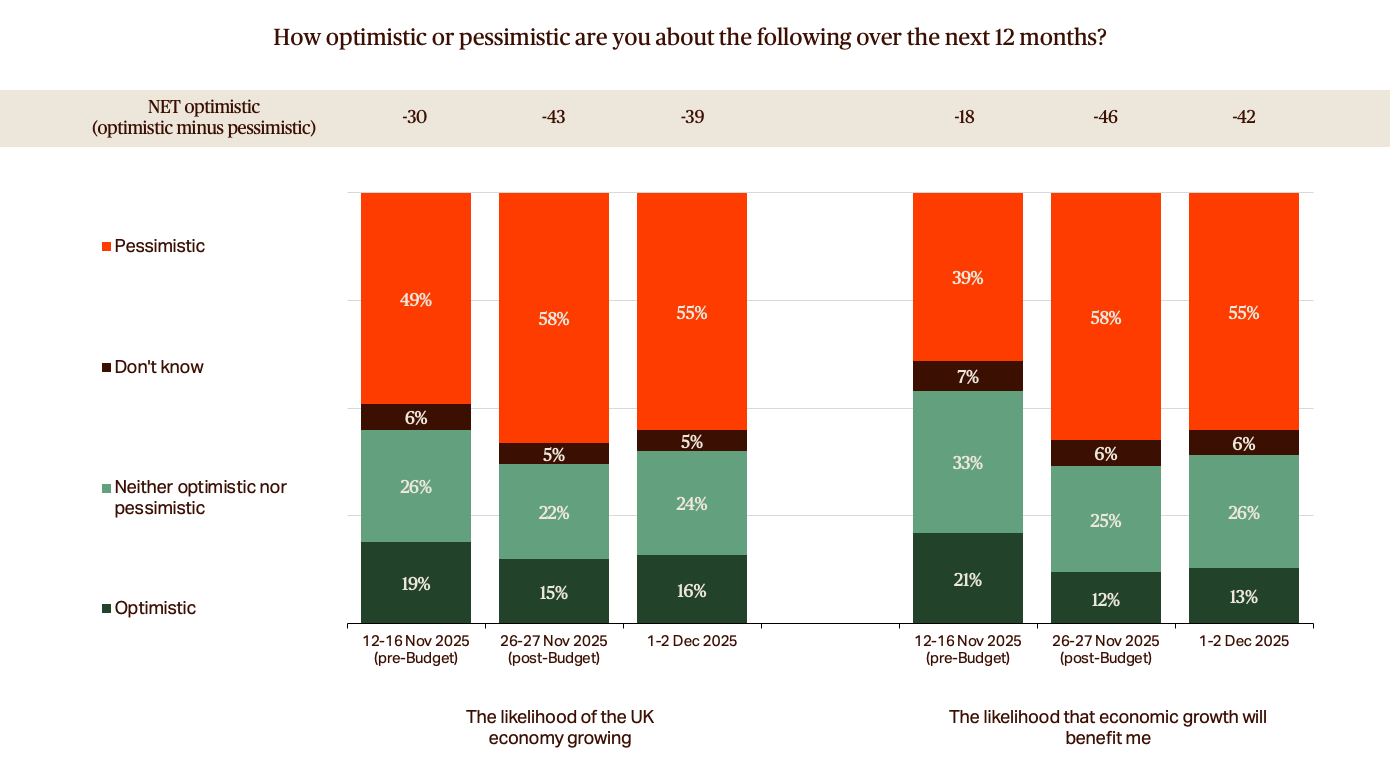
- Just 19% of UK adults were optimistic about the likelihood of the UK economy growing
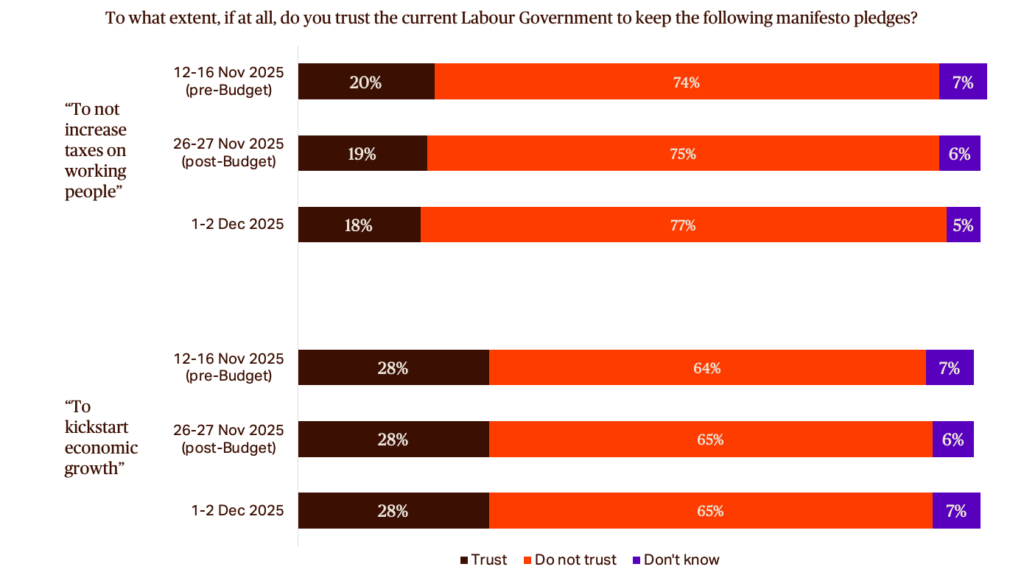
- Only 20% trusted the government (to some extent at least) to keep its promise to not increase taxes on working people
- 28% trusted the government to keep its promise to kickstart economic growth.
Separate polling from Lord Ashcroft echoed this sentiment, finding that just 2% expected the Budget to improve their personal financial situation, and 68% expected it to make it worse.
Quantifying the fallout: how the Budget eroded confidence
The national mood before the Budget announcement was, therefore, one of widespread pessimism and distrust. This was compounded by a lack of public faith in the Government’s prioritisation of growth. In our research conducted earlier in November, 34% of UK adults agreed ‘it is more important to make sure that the economy grows than to worry too much about a fairer distribution of wealth’ whereas more (38%) agreed ‘it is more important to focus on a fairer distribution of wealth than to worry too much about economic growth’.
The Budget not only failed to meet low public expectations, it widened the gulf between the government’s agenda and public sentiment. In our polling conducted in the first 36 hours after the Chancellor delivered the 2025 Budget Statement, we found that UK economic optimism fell further post-Budget.
The data reveals a significant drop in public confidence:
- ‘Net optimism’ (the % optimistic minus the % pessimistic) regarding ‘the likelihood of the UK economy growing’ over the next 12 months fell from an already low -30 pre-Budget to -43 post-Budget.
- ‘Net optimism’ regarding ‘the likelihood that economic growth will benefit me’ fell even more, from -18 to -46 post-Budget.
A week on, neither metric has yet shown much sign of significant improvement.
Decoding the public reaction: what people actually heard
The negative initial reaction to the Budget may be rooted in what cut-through to the public: the perception of tax increases, the divisive removal of the two child benefit cap, and, underlying these, the lack of trust in the Labour Government to keep its manifesto pledges.
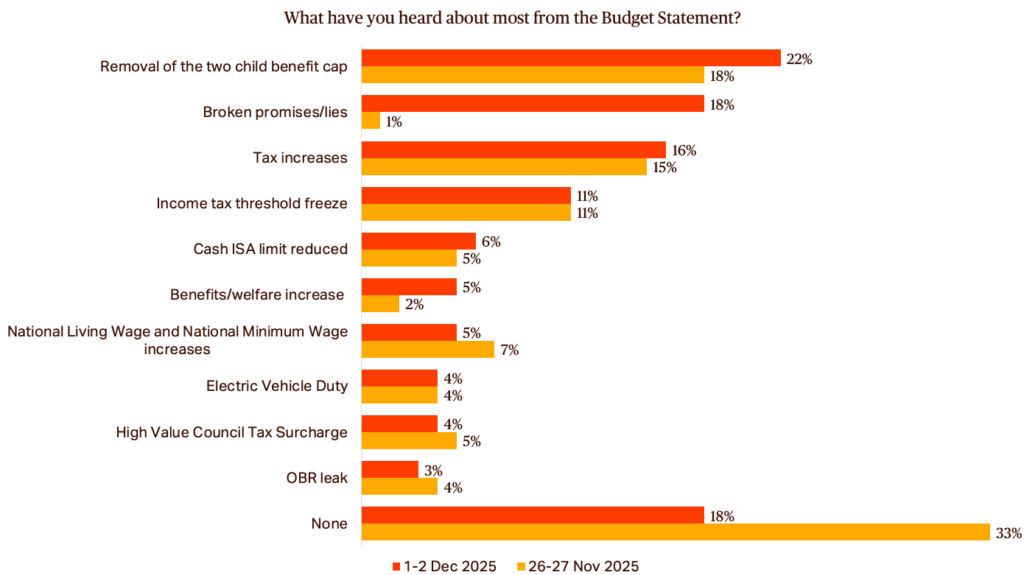
In our immediate post-Budget poll, the parts of the Budget Statement that UK adults had heard about most were the removal of the two child benefit cap (18%), unspecified tax increases (15%), and the income tax threshold freeze (11%). Tellingly, and perhaps due to the amount of pre-Budget briefing, just 1% said the absence of a rumoured income tax increase had caught their attention most.
But the narrative did not settle. After a weekend full of Budget commentary and speculation of whether Rachel Reeves had misled Parliament and the public about the state of the country’s finances, reactions to the Budget evolved. The country remained similarly pessimistic about economic growth, but many more people were able to spontaneously mention something in the Budget that they had heard about – and it was rarely a positive angle for the Government.
The public’s focus shifted, and intensified on:
- The removal of the two child benefit cap, which polling elsewhere has demonstrated to be at least divisive if not unpopular across the country.
- Increases in benefits and welfare spending, with some complaining that the Budget had increased “taxes on the working population to fund welfare and benefits”.
- A significant jump in mentions of the Government’s ‘broken promises’, ‘lies’ and ‘misleading’ statements, which rose from 1% immediately post-Budget to 18% a week later.
And – while we’ve yet to see any major decline in trust in the Labour Government to keep its manifesto pledges – trust was already perilously low, and the Budget has done very little to improve it.
Taken together, this data paints a clear picture of the difficult economic and political situation that the Labour Government must now navigate. But it also demonstrates the scale of the frustration across the country with the state of the economy and the way in which it is being governed.
Applying the insight: navigating public frustration
In such a volatile context, it is easy for a message to be lost – whether you are a Chancellor trying to communicate a positive political message or a business trying to communicate a sensitive price rise. Deeply understanding that context and the nuanced hopes and expectations of your audience is critical to ensuring your message is not lost amidst the noise.
Let’s talk about how our strategic intelligence can help you anticipate what’s next, navigate ambiguity and build a response that resonates. Get in touch today.
Methodology
This article references three recent Yonder surveys (powered by Yonder Omnibus).
- Yonder interviewed 4,124 UK adults (aged 18+) online between 12 and 16 November 2025.
- Yonder interviewed 2,084 UK adults (aged 18+) online between 26 and 27 November 2025.
- Yonder interviewed 2,077 UK adults (aged 18+) online between 1 and 2 December 2025.
- In each survey, quotas and weights were applied to ensure the sample was demographically representative of the UK adult population.