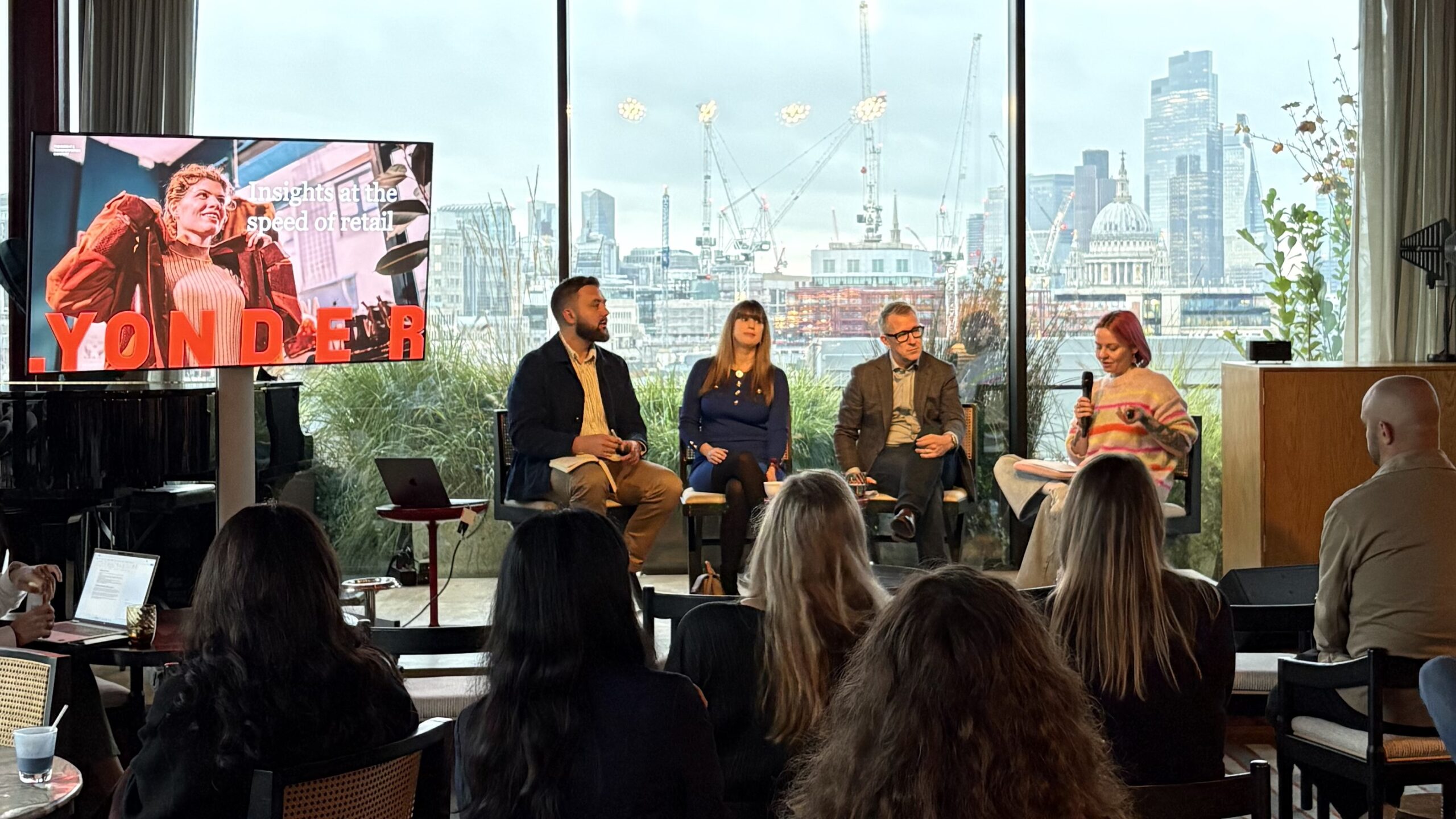
Yonder Consulting’s breakfast briefing offered three key lessons on combining the power of technology with human connections.
Where can AI offer powerful insight, and where does it risk taking businesses further away from their customers? That was the question we explored at Yonder Consulting’s breakfast briefing – Insight at the Speed of Retail – at 180 Strand on 21 October.
As a freelance journalist and former managing editor of The Grocer, I was joined by Karl Weaver, Group Managing Director at William Reed; Louis Bedwell, an independent consultant and food industry advisor; along with Laura Payten as moderator, Partner at Yonder Consulting. Together, we discussed where AI offered advantages, where it risked creating blind spots and how to translate powerful insight into action.
Here are the three key themes to come out of our discussion:
1. Talk to people
We’re seeing an explosion of new AI solutions on the market promising to help teams deliver more insights, at a faster pace.
In many ways, that stands to be a positive force. Agents can pull together information, sort data and recognise patterns, but if you rely too much on AI, you risk getting further away from your customers.
We stressed the ongoing importance of one simple premise: talking to people. That can mean going out and talking to your customers on your floor, conducting qualitative research and focus groups, or reading real customer feedback in detail.
If businesses fail to talk to their customers, they can miss the motivations and desires that are not necessarily captured in straightforward quantitative data.
For example, self-service tills are an obvious win if you look purely at waiting times. However, when looking at detailed customer feedback, you would likely find a sizeable number of customers who prefer human interaction – and who feel strongly about keeping manned tills open.
2. Keep a close eye on the future
The retail industry has reams of data measuring performance, but it tends to follow a similar format. Research by Gartner found 60% of marketing and insight dashboards track operational activity rather than business impact, and most brand trackers all leverage the same five attributes.
That means datasets can often miss opportunities for future growth or challenges that lie ahead.
We pointed to the rise of GLP-1 drugs as a prime example. The established retail data only forms part of the picture here. The real value lies in looking ahead to the future, when patents expire, tablets become more commonplace and a greater number of consumers adopt the drug. That is when we will see a potentially seismic impact on buying habits.
The fastest-growing companies are often those to act on a change or trend before it becomes mainstream, we pointed out. That level of foresight comes from looking outside of your traditional data sets.
AI can play a role in predicting the future, but we discussed how businesses should be wary of relying on the technology for this purpose. We reiterated the value of talking to customers, alongside making an effort to keep up with macrotrends in the market – following experts on social media or reading specialist press.
3. Ask the cost of failing to act
Powerful insight doesn’t always result in change. While 94% of leadership teams say research is important, just 24% reference it in almost all major decisions, according to Hey Marvin. Persuading execs to act takes more than AI-generated insight, it relies on human skills.
Leadership teams can be wary of acting on insight due to cost implications, or a simple fear of making mistakes, we noted during our discussion. So we suggested turning the scenario on its head. Instead of focusing on how much it will cost to act on the insight, ask how much it will cost to ignore the trend. What may seem like the safe choice may end up being exactly the opposite, if you miss a shift in behaviour that will truly change buying habits.
Storytelling also plays a role here. Insight teams have wealth of data at their fingertips and it can be tempting to provide leadership with everything. But here, less can be more. An array of figures can often prove overwhelming. Instead, our panel advised picking two or three powerful data points and building a story around those insights. If you can add in human case studies to back up your point, that can be even more powerful.
So ultimately, this isn’t about whether to use AI. Instead, it’s about how to use it effectively. The technology can undoubtedly act as a powerful assistant to insights teams. But if too much is delegated to an agent, you risk losing the human connection that forms the foundation of every successful business.